
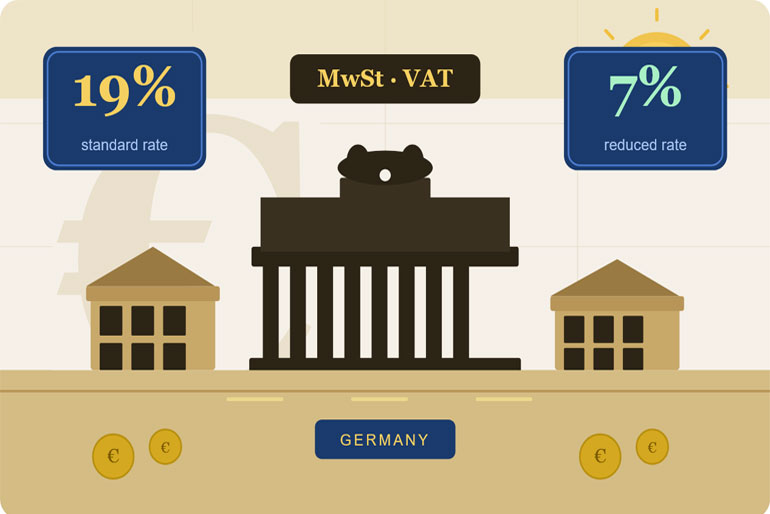
If you’ve ever bought something in Germany — whether it’s a coffee, a pair of shoes, or a new laptop — you’ve already paid VAT. You just might not have noticed it. Unlike some countries where tax gets added at the checkout counter, Germany includes it right in the price tag. What you see is what you pay.
So what exactly is VAT, and how does it work in Germany? Let’s break it down in plain language.
VAT in Simple Terms
VAT stands for Value Added Tax. In German, it’s called Mehrwertsteuer (MwSt) — which literally means “more value tax.” It’s a consumption tax, meaning it’s charged on goods and services when people buy them.
Think of it this way: every time something moves along the supply chain — from manufacturer to wholesaler to retailer to you — a little bit of tax gets added. By the time it reaches your hands, VAT has been collected at each step. But businesses along the way can reclaim the VAT they paid, so in the end, it’s mostly the final customer (you) who carries the cost.
The Two Main VAT Rates in Germany
Germany uses two VAT rates depending on what’s being sold:
19% — The Standard Rate: This applies to most goods and services. Electronics, clothing, furniture, restaurant meals, hotel stays, car repairs — if it doesn’t fall into a special category, it gets taxed at 19%.
7% — The Reduced Rate: This applies to everyday essentials and certain cultural or social goods. Things like:
- Groceries (food items sold in stores)
- Books, newspapers, and magazines
- Public transportation tickets
- Certain medical products
The idea behind the lower rate is to keep basic necessities more affordable for everyone.
Who Collects It and Who Pays It?
Businesses registered for VAT in Germany collect it on behalf of the government. When you buy something, the seller adds VAT to the price, then passes that amount along to the tax authority (Finanzamt).
As a customer, you don’t file anything or deal with the process directly. It’s all handled behind the scenes. That said, if you’re a business owner or freelancer working in Germany, VAT becomes something you’ll need to understand and manage carefully — including when to charge it, when to claim it back, and how to file returns.
Using a Tax Calculator Germany Tool
If you’re trying to figure out how much VAT is included in a price — or how much gets added on top — a tax calculator Germany tool makes things much easier.
Here’s a quick example of how the math works:
To find the price without VAT (19% rate): Take the gross price and divide by 1.19. → €119 ÷ 1.19 = €100 (net price)
To add VAT to a net price: Multiply the net price by 1.19. → €100 × 1.19 = €119 (gross price)
For the 7% rate, you’d use 1.07 instead. Online tax calculators handle this automatically — just plug in the amount, pick the rate, and you get your answer in seconds. They’re useful for freelancers, small business owners, or anyone shopping across borders.
Does VAT Apply to Everyone?
Most businesses in Germany must register for VAT once their annual revenue passes €22,000. Below this threshold, they fall under the Kleinunternehmerregelung (small business rule), which lets them skip charging VAT — and also means they can’t reclaim it either.
For foreign visitors, there’s actually a VAT refund option. If you live outside the European Union and you buy goods in Germany, you may be able to claim back the VAT when you leave. Shops that participate will give you a form to fill out, which you then stamp at the airport or border before you depart.
A Few Things Worth Knowing
- VAT is already included in displayed prices: When you see a price in a German shop or restaurant, VAT is baked in. No surprise at checkout.
- Receipts show the VAT breakdown: German receipts typically list the net amount, the VAT amount, and the gross total separately — so you can see exactly what you paid in tax.
- Services can be tricky: Some services have exemptions. For example, certain healthcare services, educational courses, and financial services are VAT-exempt entirely.
- E-commerce has its own rules: If you’re selling online to customers across Europe, EU VAT rules apply, which can get more complicated depending on where your buyers are located.
Why Does Germany Have Such a High Standard Rate?
At 19%, Germany’s standard VAT rate sits on the higher end compared to some other countries — but it’s fairly typical within the European Union. France, Italy, and many other EU members have similar or even higher rates. The revenue collected helps fund public services like healthcare, education, infrastructure, and social programs.
Germany temporarily reduced VAT to 16% and 5% in mid-2020 as part of a COVID-19 economic relief package, but rates returned to normal by January 2021.
Bottom Line
VAT in Germany is a straightforward concept once you know what you’re looking at. You pay it every time you buy something; it’s already included in the price, and the rate is either 19% or 7%, depending on the product. If you’re running a business, the details get deeper — but for everyday life, it’s mostly invisible.
And whenever you need to crunch the numbers, a tax calculator Germany tool takes the guesswork out entirely.
Leave a Reply