
If you’ve ever bought something in Germany — a coffee, a jacket, or even a software subscription — you’ve already paid Value Added Tax without thinking much about it. It’s quietly baked into the price of almost everything. But what exactly is it, how does it work, and why does it matter? Let’s break it down in plain language.
The Basic Idea
Value Added Tax, known in German as Mehrwertsteuer (or just MwSt), is a consumption tax applied to goods and services. The keyword here is “consumption” — it’s designed to tax people at the point of spending, not earning.
Unlike income tax, which is charged on what you make, VAT is charged on what you buy. Every time a product moves along the supply chain — from raw material to finished product to store shelf to your hands — a small amount of tax is added at each stage. By the time it reaches you, the full tax has been collected, and you’re the one who ultimately pays it.
The Two Rates You Need to Know
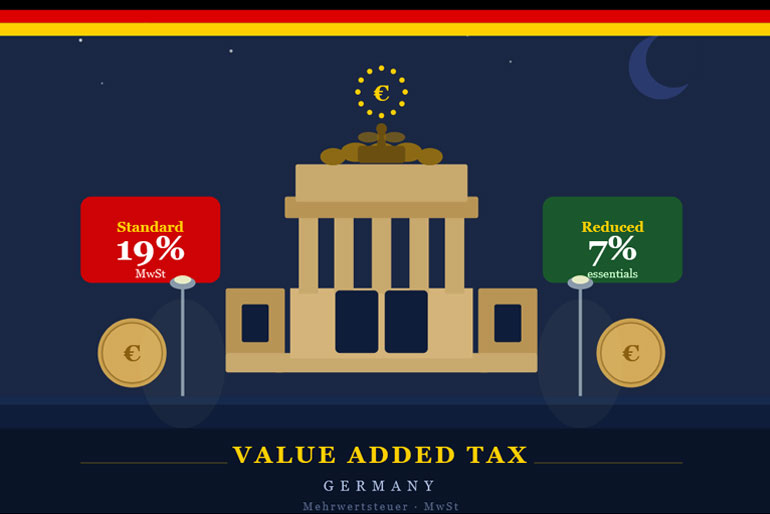
Germany uses two main VAT rates:
Standard rate — 19%: This applies to most everyday goods and services. Electronics, clothing, restaurant meals, hotel stays, car repairs — pretty much anything that doesn’t fall into the reduced category.
Reduced rate — 7%: This covers essentials and certain cultural goods. Think groceries, books, newspapers, public transport, and medicine. The idea is to keep basic necessities affordable for everyone.
There’s also a 0% rate for specific items like international exports, but that’s more relevant for businesses trading across borders.
Who Actually Pays It?
Here’s where it gets interesting. Technically, businesses collect VAT — but they don’t keep it. They act as middlemen between the consumer and the government.
When a bakery sells you a loaf of bread for €2.14, around 7% of that price is VAT. The bakery collects it, holds it temporarily, and then hands it over to the German tax authority (Finanzamt). You, the buyer, are the one who actually bears the cost.
For businesses, it works like a relay race. A manufacturer charges VAT to a wholesaler. The wholesaler charges VAT to a retailer. The retailer charges VAT to you. At each step, businesses can reclaim the VAT they paid to their suppliers — this is called “input tax deduction” (Vorsteuerabzug). In the end, only the final consumer has no one to pass the cost to.
Why Does Germany Have VAT?
VAT is one of the German government’s biggest revenue sources. It funds public services — roads, healthcare, schools, social security, and more. It’s also a requirement of being an EU member state; all EU countries must have a VAT system, though the exact rates differ from country to country.
The system is also considered relatively fair because it’s tied to spending. People who spend more pay more tax. Basic necessities like food are taxed at a lower rate, which helps lower-income households.
VAT for Tourists and Non-Residents
If you’re visiting Germany from outside the EU, you may be eligible to claim back the VAT you paid on purchases — particularly on goods you’re taking home with you. This is done through a tax refund process at the airport or border crossing. Retailers who participate in the scheme will give you a special form at the point of purchase.
Keep your receipts, fill out the paperwork, and you could get a portion of that 19% back before you leave. Not a bad deal.
How to Calculate VAT in Germany
Figuring out VAT doesn’t require a finance degree. Using a tax calculator Germany tool makes this straightforward, but the math itself is simple:
To add VAT to a net price: Multiply the price by 1.19 (for 19%) or 1.07 (for 7%).
Example: A product costs €100 net → €100 × 1.19 = €119 gross
To remove VAT from a gross price: Divide by 1.19 (or 1.07) and subtract the original.
Example: You paid €119 → €119 ÷ 1.19 = €100 net, so VAT = €19
A reliable tax calculator Germany will handle both directions instantly, which is especially useful for freelancers and small business owners who need to issue correct invoices.
VAT and Freelancers
If you’re self-employed or running a small business in Germany, VAT becomes something you actively manage, not just passively pay. You’ll typically need to register for VAT, charge it on your invoices, and file regular VAT returns with the Finanzamt.
There is one exception: the Kleinunternehmerregelung (small business rule). If your annual revenue stays below €22,000, you can opt out of charging VAT altogether. This simplifies things a lot for people just starting out.
The Bottom Line
Value Added Tax in Germany is straightforward once you understand the core idea: it’s a consumption tax, split between a standard 19% and a reduced 7%, collected by businesses but ultimately paid by the end consumer. Whether you’re a tourist, an expat, or a freelancer, knowing how VAT works helps you understand your costs and your rights. And when the numbers get tricky, a good tax calculator Germany is always just a click away.
Leave a Reply